

delabs circuits
Electronic Engineering Schematics
Design of a Constant Current Source
This article will explain the way a simple transistor based current source is designed, this will give an idea on how some components can be used in a practical way to make the circuit do some function, the objective is not design but to become familiar with the basic ideas.Requirement
We need a fixed current around 20mA for a voltage variation of 10V to 20V to drive a LED flasher circuit.Component Selection
The transistor should handle 20V * 2 = 40V and a current of 20mA * 5 = 100mA. We have to overrate the components for long term reliability and make the design rugged. Chosen MPSA92 PNP-300V-500mA which is good for this job. 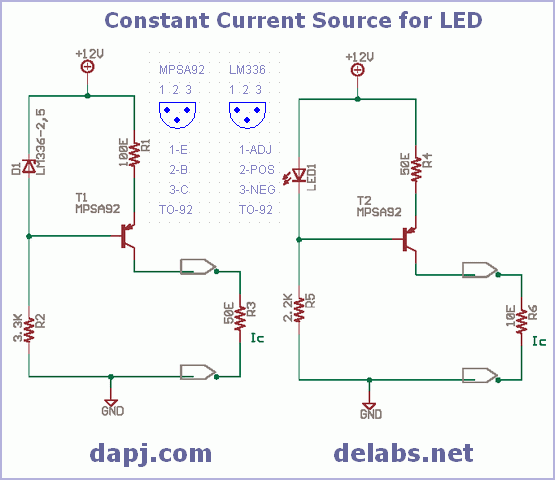
FET Current Source and MOSFET
12-Bit, 4-20mA Loop-Powered System
Circuit design
The LED at 40mW will last long, some energy emits as heat and some as light. 40mW / 1.6V = 25mA. so let us choose 20mA max LED current as a thumb rule. 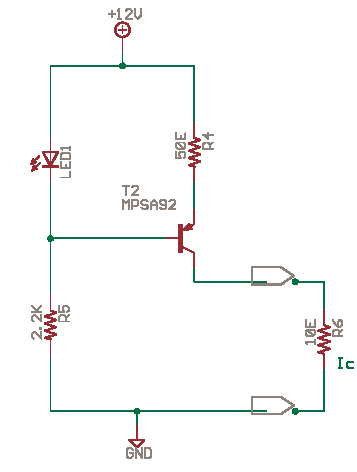
In this circuit the LED is used as a reference so to keep it cool a 2.2K is chosen. (20V - 1.6V) / 2.2K = 8.3mA on the high side and when voltage is 10V the current will be 3.8mA min. .
You should know that the LED forward drop can change with ambient light as it is photo sensitive and will vary with temperature.
Look at the circuit in the right, the LED has a forward drop of 1.6V which is applied across the resistor R4 and the base-emitter diode. That means 1V across R4 as a diode drop is around 0.6V. The base-emiter now gets forward biased and a small base current Ib flows . The Ic or collector current is 1V / 50E = 20mA. The Ib = Ic / beta, That means 20mA / 25 = 0.8mA which flows thru R4 and R5.
The Load Resistor R6 represents the LED flasher circuit that consumes 20mA, even on short circuit of R6 the current is limited to 20mA.
When more current flows in R6 the voltage at emitter falls, the voltage at base is 20V - 1.6V =18.4V, and the voltage at emitter should be 18.4 + 0.6V = 19V for bias and Ib to flow. When Ic increases the Ib reduces to that extent as only to maintain emitter voltage at 19V, this way Ic is kept constant, if Ic reduces the voltage at emitter builds up to rise Ib which in turn builds up Ic. so we made a current regulator.
Building a mV Milli-Volt Calibrator Source
Circuit Improvement
The circuit can be improved by using a zener in place of the LED or better still a temperature compensated reference like LM336.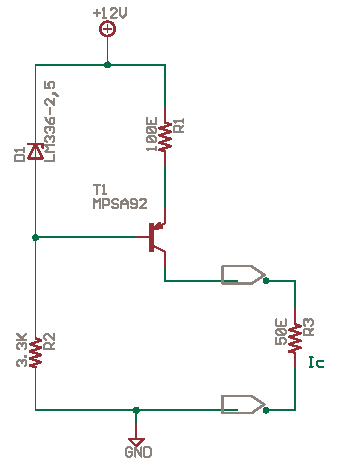
The circuit on the right will be more stable, but still the forward drop on base-emitter junction is temperature sensitive. The base current will also introduce an error, so you can get a 8 bit stability, that means around 255 counts on an A-D converter. If you need a more stable current source you should design with FET and opamps.
LM336-2.5 has a 2.5V drop. A LM336-5.0 is also available for 5V. these are from National Semiconductor.
Operating Current of LM336 is 400uA to 10mA, 20V The max. voltage 20V / 3.3K = 6mA. so within limits. Then you can compute the rest, wire it up to see if your design works.
"If all parts are working, connected in
proper polarities and there are no dry solders and loose
connections then any circuit well designed ought to work."
Solderman Talks 1702 AD
Back to Basics and Instrumentation
...
...
...
...
...
delabs Technologies
30th Aug 2020
...
The documents, software, tools and links are provided to enhance the ability of an electronics student, hobbyist or professional by sharing information. The information, links etc. should be used by the website visitor, at his or her own risk and responsibility. There may be concept, design and link errors in the pages.
Creative Work, ideas and documents of delabs can be used for Product Design and Development by R&D Engineers, Hobbyists, Students and even firms for creating useful products. These cannot be used for reprint, replication or publishing online or offline.