

delabs circuits
Electronic Engineering Schematics
80C51, SBC, MCS-51, Firmware and Circuits
8052 Microcontroller :
80C51 Single Board Computer SBC and Firmware Code. Interface 8051 or 8052 to PC on a RS-232 or
serial port. Microcontroller Board and learn about MCS-51.
EdSim51 - 8051 Simulator
8048 and MCS-48 made designing with Microprocessors easy, with built in I/O ports, RAM and Timer. The I/O ports for the 8085 was an external 8255. 8749 enabled users to burn and test firmware on an integrated UV Eprom.
80C51-52 which came out as the fully evolved uC had built in Serial Ports UART and more Math, better Timer-Counter and Interrupt Handling. The 'C' is for CMOS that made handheld instruments possible due to low battery usage and lesser support chips.
MCU 8051 IDE and other Tools
The Assembly Code MCS-51 set is used to program the chip. There is a 8052 Basic that can understand the Basic Language, useful for people who are not comfortable with mnemonics.
Now we have 8051 chips with EE Flash and some have a watchdog and I2C too.
determ - Serial Terminal Software
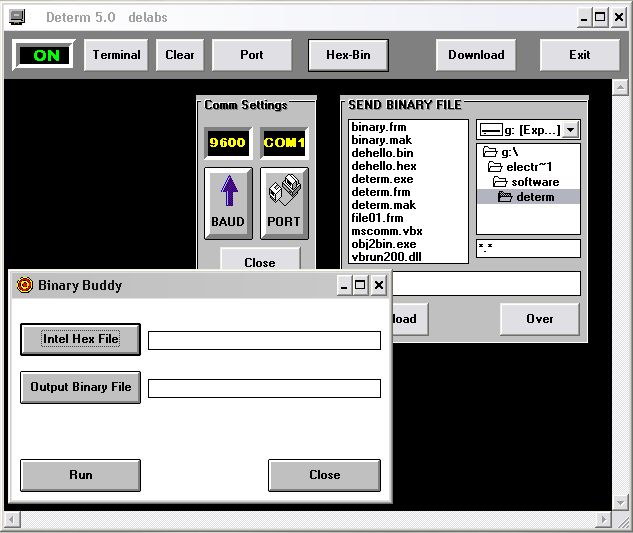
Using this used to help in testing the program on a Battery
backed up Ram. The final program could be burnt on the Eprom
which was erased in UV Box and could be rewritten probably 50
times only. Hence testing and debugging in the RAM is much
easier. You could use Software Test Points to tell the PC the
status of each stage of the program. This helps in debugging
or building software block by block.
8051
Single Board Computer - This is a Kit you can use to
learn the 8051 family.
8051 SBC Operating System :
This is a 8051 Operating System ;-) . In an old elektor
issue, around 1990 perhaps, i got a 8031 circuit and monitor
code by Grodzik. This helped me interface a 8051 to PC via
RS232-serial-comm port with HyperTerminal. Now you can use Termite
- a simple RS232 terminal to transfer and receive
bits-n-bytes to the outside world.
Related Circuits that were hand drawn
- 555 based Asm Loader in the RAM.
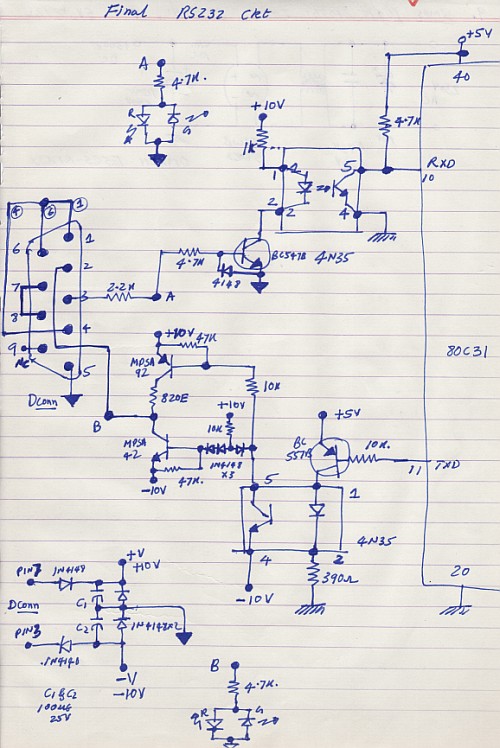
- A Optically Isolated RS232 Interface.
- IO port and Interface a ICL7135.


Intel 8051 80C31 Block Diagram

dact2007.asm.htm,
- equat.asm.htm, - prog.asm.htm
8051-OS-SRC.zip a
zip file with the code. 80C51 SBC code examples here 80C51-RS232.zip. This
was a Serial Interface of ICL7135 14 BIT 4-1/2 A/D with
80C31. determ.zip
is a terminal i made on VB2.
See also 8031 OS
Spreadsheet and 8031
Examples Spreadsheet
Most files are created before 1992. Then i have edited
them and tried to make fit for publishing online in 2000. They
may have errors and may not work as indicated.
...
...
...
...
...
delabs Technologies
20th Apr 2020
...
The documents, software, tools and links are provided to enhance the ability of an electronics student, hobbyist or professional by sharing information. The information, links etc. should be used by the website visitor, at his or her own risk and responsibility. There may be concept, design and link errors in the pages.
Creative Work, ideas and documents of delabs can be used for Product Design and Development by R&D Engineers, Hobbyists, Students and even firms for creating useful products. These cannot be used for reprint, replication or publishing online or offline.