

delabs circuits
Electronic Engineering Schematics
Precision Attenuator with Digital Control
The analog front end may carry high energy components, protection and attenuation may be needed to bring it to safe levels. After Signal Conditioning measurement can be made.The Circuits DACT0008 and DACT0009 are both useful in building instruments which have digital control.
Precision Attenuator with digital control
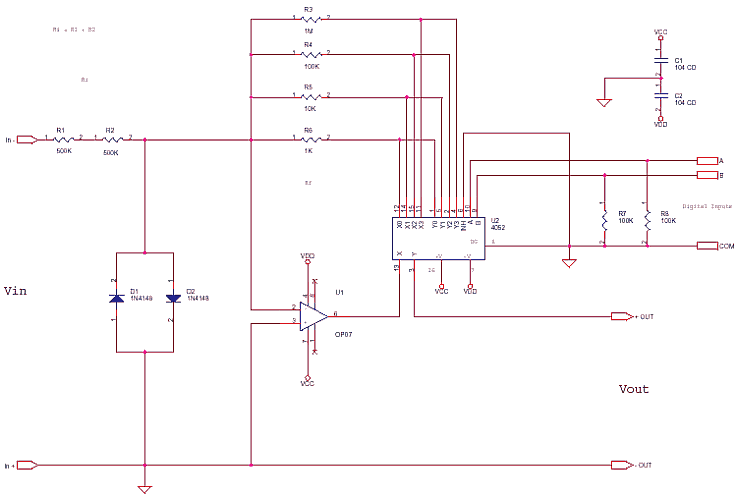
The Circuit DACT0008 is a programmable attenuator and the digital control can be a remote dip switch, a CMOS Logic Output like the A-B-C-D outputs of a decade counter, or an I/O port of a uC like 80C31.The heart of the circuit is the popular OP07 OpAmp with Ultra Low Offset in the inverting configuration, 4052 a CMOS analog multiplexer switch enables the gain change, the innovation of the circuit is that the on resistance ( around 100 ohms) of 4052 switch is bypassed so that no error is introduced by its use.
Linearizing Circuit for Thermocouples
The resistors used R1 to R6 can be 0.1% 50ppm if you will use a 3 ½ DPM i.e. + /- 1999 counts ( approx. 11 bit ), but for 4 ½ DPM ( approx. 14 bit ) you may need to have trimpots2 in place of R3, R4, R5 & R6 gain selection resistors to properly calibrate to required accuracy but for testing or trials use 1% 100ppm MFR resistors but the errors will be around 1%.
To keep parts count (hence cost) to minimum the common or ground is used as the positive input and negative being one end of R1 this is because the OpAmp inverts the polarity as it is used in inverting configuration, this does not matter as the equipment will be isolated by the power supply transformer and all polarities are relative, but if common has to be negative then add U4 and U5 as shown in DACT0009.
High Resistance LED Meter
The OP07 pin out is based on standard single OpAmp 741 and any other OpAmp like CA3140, TLO71, LF351 Can be used but with a lot off offset errors but for trials any OpAmp may do but the errors may be > 1% and this is not tolerable n precision instrumentation. OP07 has also equivalents like uA714 & LM607 ultra low offset < 100uV and low input bias <10nA and high input impedance >100M are the key requirements for a good instrumentation amp for DC inputs.
Vout = -(Rf/Ri) * Vin -o- Gain = Av = Rf/Ri
| Digital
Inputs - Logic 0 is 0V Logic 1 is 5V |
|||
| X Y Value |
B |
A |
Gain Av |
| 0 |
0 |
0 |
1/1000 |
| 1 |
0 |
1 |
1/100 |
| 2 |
1 |
0 |
1/10 |
| 3 |
1 |
1 |
1 |
1 : A-B : A, B, C, D is 20 21 22 23 is 1, 2, 4, 8 respectively.
2 : trimpots : e.g. replace R6 1K by 200E trimpot + 900E MFR. 900E can be from 1K parallel to 10K MFR.
Design Background
a. Input 500 V max
1/4 W Resistor can withstand 250V D1 and D2 Clamps the voltage to +/-0.5V thereby protecting OpAmp. R1 and R2 Limit the current also. D1 and D2 Clamps the voltage to +/-0.5V therby protecting OpAmp.
b. Output
Output connect to DPM 7107/7135 or any other A/D Convertor or OpAmp Stage. Use a buffer at output if output has to be loaded by a value less than 1Meg. Use an inverting buffer if input leads have to have polarity where gnd is -In. See DACT0009 for details.
Build your own Meters and Instruments
c. 4052 CMOS Switch
The 4052/51/53 Analog Multiplexers have an on Resistance of around 100E the highlight of the circuit is that the CMOS on resistance comes in series with the opamp output source resistance, which produces no error at output.
Digital Control Options
A and B can be controlled by I/O port of uC, like 80C31 so that the uC can Control gain. A and B can be given to Counters like 4029/4518 to scroll gain digitally. A and B can be connected to DIP switch or thumbwheel switch.Caution !!!
Circuit does not isolate only attenuates. When high voltage is present at input any part of circuit is a danger to touch.
Back to Basics and Instrumentation
...
...
...
...
...
delabs Technologies
30th Aug 2020
...
Disclaimer and Terms of usage
The documents, software, tools and links are provided to enhance the ability of an electronics student, hobbyist or professional by sharing information. The information, links etc. should be used by the website visitor, at his or her own risk and responsibility. There may be concept, design and link errors in the pages.
Creative Work, ideas and documents of delabs can be used for Product Design and Development by R&D Engineers, Hobbyists, Students and even firms for creating useful products. These cannot be used for reprint, replication or publishing online or offline.