

delabs circuits
Electronic Engineering Schematics
Industrial Process Control Circuits
- 4-20mA 2W Non-Isolated Transmitter
- 4-20mA 2W Output 0.2-1.0V
Input
- 4-20mA 3W Output K Type Thermocouple
- 1-5V 3W Output RTD Pt-100 Input
- 8 Channel 4-20mA Analog Multiplexer
Project Pages
- Mini RTD Pt-100 Three Wire Transmitter
- RTD PT100 Mains Powered Transmitter
- Blind Dial Analog Temperature Controller
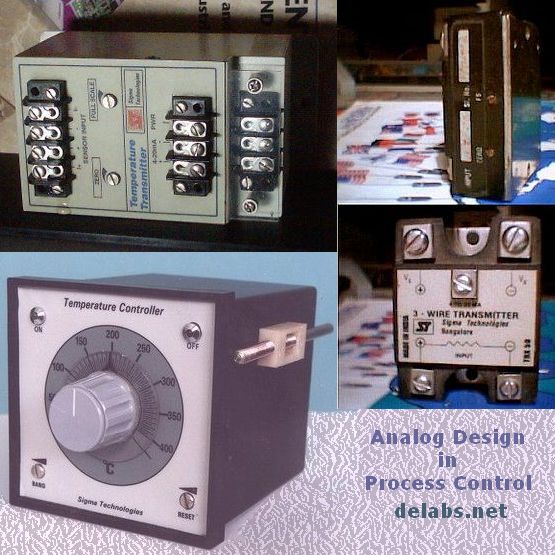
Analog Design in Process Control is seen at the Sensor Signal Conditioning Stage. Controllers also use Opamps for Analog Computation Tasks. These are Real Time in the Truest Sense.
Precision Temperature Control with PID and SSR
A closed loop controller is the heart of an Industrial
Automation System. Right from an On-Off Hysteresis Controller
to a Auto Tune PID Controller, we find solutions of different
complexities. Each solution might suit a particular system;
depending on the requirements of Ease-of-use, Cost and Process
Type.
Even today, the controllers at every stage of evolution, from the thermostat to Auto-Tune, are used in many countries, for many different industrial applications. No solution above is obsolete! The developing Countries still use electro-mechanical or semi-automatic means for control in some areas.
The Evolution of Temperature Control
- Bimetal Thermostat
- Analog Dial On-Off Controller.
- Analog Dial Proportional Controller.
- Digital Display - Analog Controller - On-Off.
- Digital Display - Analog Controller - Proportional.
- Digital Display - Analog Controller - PID.
- Microcontroller Based Process Controller. (On-Off, Prop., Universal TC, RTD, mA Input)
- Process Profile Controller (Microcontroller Based).
- Microcontroller Based Fuzzy or Auto-Tune PID Controller.
- Data Logger, Computer, PLC or SCADA based Solutions.
A PC based multiplexed scanner controller with
data-acquisition cards and I/O Cards can be solution for
Laboratory or Research. This is used when real time control is
not required or where the control failure will not lead to
damage or loss.
The
Control of engineering systems
A PLC or Microcontroller based controller should be used with
a Analog Controller Protection or Over temperature Trip-Alarm.
Outputs could be Relay or SSR, Voltage and Current outputs
like 0-10V and 4-20mA are needed sometimes to drive DC/AC
Drives or to control Motorized Valves. Relays and SSR can be
On-Off or Time proportional (PWM). The Cycle times can be
10-20 Secs for Electromagnetic Relay and around 1 Sec for SSR.
This is because Mechanical Relays and contacters have limited
number of operations. The zero crossing SSR has to be cycled
slower than mains frequency.
Linearizing
Circuit for Thermocouples
In Curing rubber, which is one of the more complicated process, we need a profile based controller, which also triggers other timers or counters which need to be activated at different segments.
When a very big area is controlled, with materials or load placed un-symmetrically, Every corner or section has to have separate sensor and controller. These are then governed by a SCADA, Supervisory PLC or Master Controller.
Even a Big Die for Plastic Moulding with an Unsymmetrical Object or long object to be moulded; needs compensation for sides which will absorb more heat.
- Relay or 4-20mA output PID controller
- Analog Section - Isolated
Transmitter
- Power Supply - Isolated
Transmitter
- Differential Amp - Isolated
Transmitter
- Process Controller - Block
Diagram
- Control Card - Process Controller
- Display Card - Process Controller
- Signal Conditioning - Process Controller
- 4-20mA Output Proportional Controller
- Signal Conditioning
Differential Amp
...
...
...
...
...
delabs Technologies
20th Mar 2020
...
The documents, software, tools and links are provided to enhance the ability of an electronics student, hobbyist or professional by sharing information. The information, links etc. should be used by the website visitor, at his or her own risk and responsibility. There may be concept, design and link errors in the pages.
Creative Work, ideas and documents of delabs can be used for Product Design and Development by R&D Engineers, Hobbyists, Students and even firms for creating useful products. These cannot be used for reprint, replication or publishing online or offline.